MACHINE LEARNING IN BIOINFORMATICS
APPLICATIONS OVERVIEW
Published on: February 12, 2026
The intersection of machine learning (ML) and bioinformatics represents a transformative fusion of technology and biology. With the advent of high-throughput sequencing technologies, bioinformatics now generates massive datasets rich in information but challenging to interpret. Machine learning, with its ability to detect patterns and learn from complex data, has become a critical tool in modern biological research. From predicting gene function to accelerating drug discovery, ML is reshaping how we understand life at the molecular level.
Understanding Machine Learning
Machine learning is a subset of artificial intelligence (AI) that enables computers to learn from data and improve their predictions over time without being explicitly programmed.
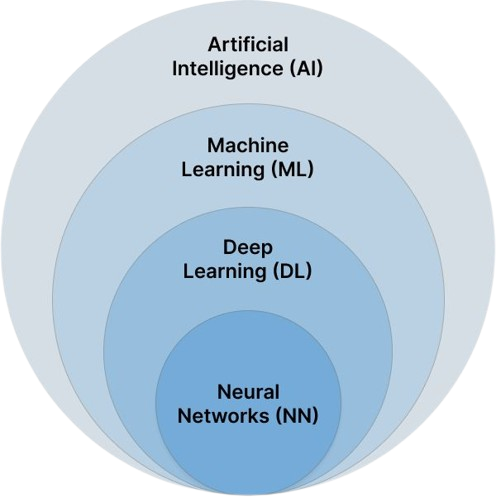
ML a Subset of AI
In bioinformatics, ML techniques help analyze genomic sequences, protein structures, transcriptomic data, and clinical records — uncovering patterns that are otherwise impossible to detect manually.
Applications of Machine Learning in Bioinformatics
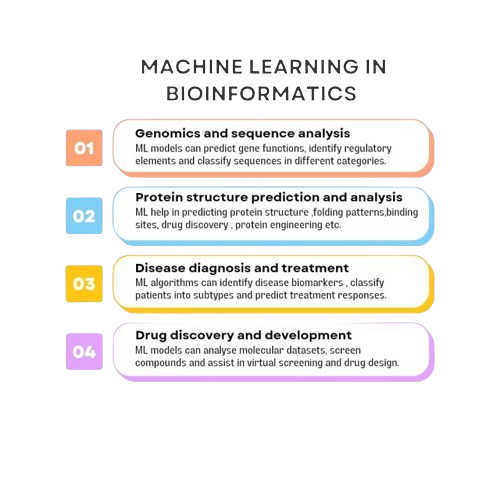
- Genomics
- Predict Gene Function: ML models analyze expression patterns to predict unknown gene roles.
- Identify Genetic Variants: Detect SNPs and mutations associated with diseases.
- Genome Assembly: Improve accuracy and speed of assembling sequencing reads.
- Proteomics
- Protein Structure Prediction: Tools like AlphaFold use deep learning to predict 3D structures.
- Mass Spectrometry Analysis: Identify and quantify proteins in complex samples.
- Protein–Protein Interaction Prediction: Understand cellular pathways and disease mechanisms.
- Transcriptomics
- Classification of cell types from single-cell RNA-seq data.
- Detection of differentially expressed genes.
- Prediction of alternative splicing events.
- Drug Discovery
- Predict drug-target interactions.
- Drug repurposing using existing datasets.
- Toxicity prediction to reduce clinical risks.
- Disease Diagnosis & Prognosis
- Analyze genomic and imaging data for disease detection.
- Predict disease progression for personalized treatment.
Challenges and Future Directions
- Data Quality: ML models require well-annotated datasets.
- Interpretability: Deep learning models often act as “black boxes.”
- Computational Cost: Training models demands high-performance computing.
Despite these challenges, advancements in explainable AI, cloud computing, and improved biological datasets are making ML more reliable and accessible.
Conclusion
Machine learning is revolutionizing bioinformatics by turning massive biological datasets into actionable insights. From genomics to personalized medicine, ML is accelerating discoveries and reshaping the future of healthcare and life sciences.
As biological data continues to grow exponentially, the synergy between machine learning and bioinformatics will drive groundbreaking innovations in research, medicine, and biotechnology.
🧠 Learn, Predict, Transform! 🧬